
Hemet City Directory Collections
The collection map below keeps proven holdings separate from assumptions. The Library of Congress catalog carries the digitized telephone material. The local library, HSJGS, Hemet Museum, and the National Archives supply complementary sources. A printed directory is most useful when its year, format, and keeper are named before the search begins.
| Collection | Years | Where held | Access and contribution |
|---|---|---|---|
| History and Directory of Riverside County | 1893-94 | Library of Congress | Digitized county directory at the county’s formation era |
| Hemet white/yellow pages, reel 1 | Jan. 1943-Nov. 1952 | Library of Congress | Listed subscribers and business categories |
| Hemet white/yellow pages, reel 2 | Nov. 1953-Nov. 1957 | Library of Congress | Alphabetical subscribers and business listings |
| Hemet white/yellow pages, reel 3 | Nov. 1958-Sept. 1962 | Library of Congress | Continued address and telephone trail |
| HSJGS obituary index | 100+ years | Duffin Heritage Room / HSJGS | 138,000+ name and date leads to newspapers |
| The Hemet News | Most issues, 1894-1999 | Hemet Museum research collection | Local events, residents, addresses, and obituaries |
| Federal census | Through 1950 | NARA | Households and addresses; Hemet EDs 33-18, 33-19, 33-20 in 1950 |
The November 1952 to November 1953 gap in the three telephone ranges should be checked against the scans rather than silently filled. The catalog is evidence of a run, not proof of every issue or publisher.
Hemet City Directory Telephone Run
The verified Hemet telephone-page material from 1943 through 1962 is organized as white and yellow pages. White pages use an alphabetical subscriber sequence. Yellow pages use business categories. A white-page entry can include a surname or initials, street address, locality, exchange, and telephone number. A yellow-page entry can include business name, category, address, and telephone.
Subscriber status is the key limit. A person may be absent because the household had no listed service, used a different name, or fell outside the issue’s coverage. Presence shows a listing at a point in time. It does not establish the exact move-in or move-out date. Search close issues to narrow a change, then compare the result with census, news, or parcel evidence.
The Library of Congress scan should be read at the issue level. Record the month, page, spelling, initials, address, and exchange. OCR can miss a faint character, and a handwritten note or damaged page can change the search result. A scanned entry deserves a check before it becomes a family-history fact.
The local image record from the Hemet-San Jacinto Genealogical Society points to the companion research shelf that helps interpret the digitized run.
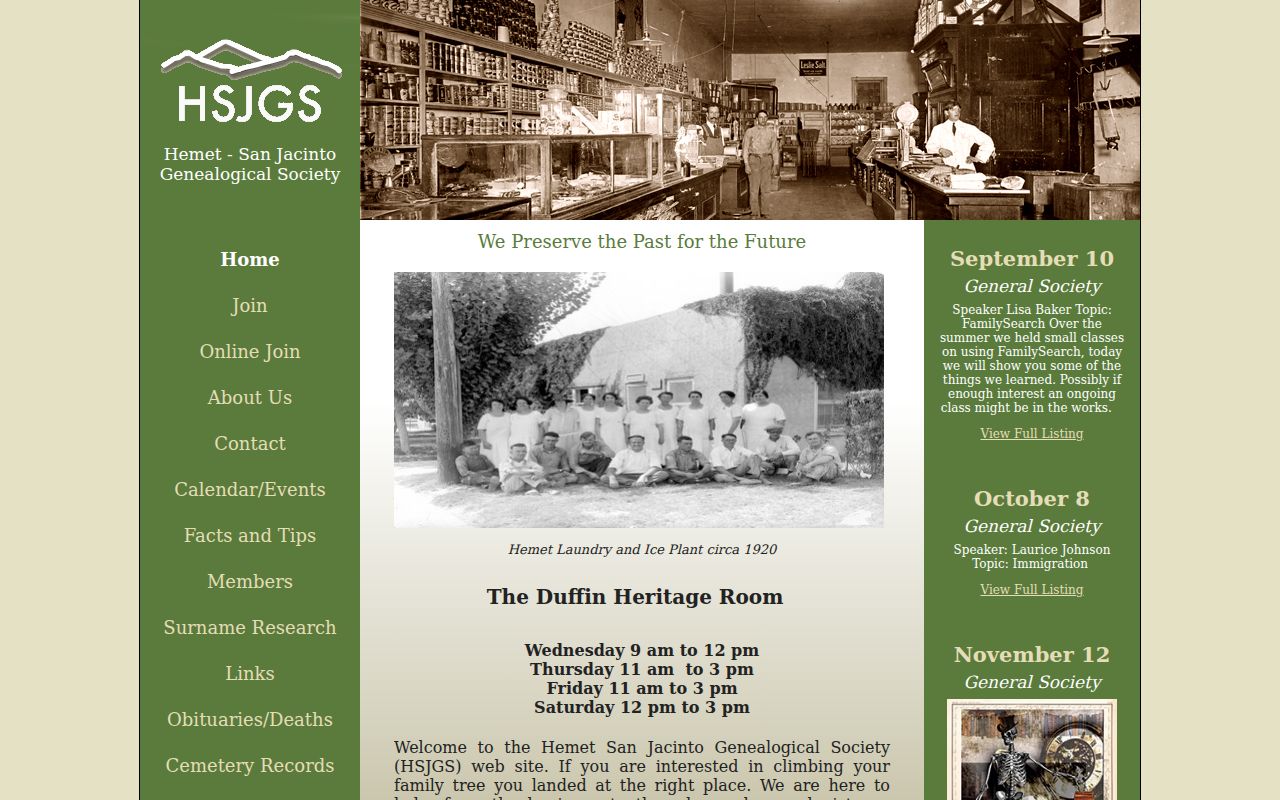
Printed telephone pages and local-history databases answer different parts of the same address question, so keeping both in the search note prevents overclaiming.
Hemet City Directory at County Formation
The 1893-94 History and Directory of Riverside County sits at an important archive turn. Riverside County formed on May 9, 1893 from parts of San Bernardino and San Diego Counties. A Hemet-area name before that date may be cataloged under predecessor San Diego County, while the first Riverside directory captures the new county setting.
The Library of Congress item is digitized, but its metadata does not supply a verified local publisher profile. Inspect the title page and entry pages. Do not infer a complete local directory series from one county volume. The collection can provide a dated name, place, business, or county context when the page itself supports that reading.
Use the county directory as a starting point, then pair it with a deed, newspaper, map, church or family source held by the Duffin Heritage Room. That approach respects both the value and the narrow scope of an early volume.
Hemet Directory Research in Duffin Room
The Duffin Heritage Room is the local counter for an old address that does not resolve online. Volunteers assist Wednesday through Friday from noon to 4 and Saturday from 9 to noon. The library offers Hemet card access to in-library genealogy databases through HSJGS. The wider HSJGS description includes almost 7,000 books, maps, and resources, four computers and printers, and a microfilm reader-printer.
The formats matter. Books, newspapers, periodicals, pamphlets, maps, manuscripts, photographs, portraits, prints, microfilm, artifacts, and architectural or engineering plans can preserve a name without using the word “directory.” A family-history question may need an obituary index, a newspaper story, a map, and a telephone page in one visit.
The obituary index contains more than 138,000 entries across over 100 years. A name and date can lead to an obituary or newspaper page, relatives, club ties, a business, or an old address. It is a finding aid, not a certified death record, so a vital-record request remains separate.
Reading a Hemet City Directory Entry
A Hemet directory entry should be transcribed, not embellished. The verified telephone run does not establish spouse parentheses, widow notation, or owner/renter marks. A category page can show a business and its contact line, but it should not be expanded into a household claim.
| Visible element | What it can support | What it cannot prove |
|---|---|---|
| Subscriber name or initials | A listed name in the issue | Exact identity without another anchor |
| Street address and locality | A printed location at that issue date | Ownership or current occupancy |
| Exchange and number | The listed telephone connection | That the number stayed with the person |
| Business category | A business listing and contact path | Every person connected to the business |
Initials deserve care. Search surname variants, compare adjacent issues, and write down the page image rather than relying on a text hit. The entry is a dated snapshot inside the Hemet collection, not a complete population record.
- Householder index
- An index that points from a household or address to a listed person. No verified local series with that label was found.
- Criss-cross directory
- An address-first directory format. The local telephone reels are not proven to be criss-cross books.
- Abbreviation key
- A publisher’s guide to shortened words or symbols. The verified run does not establish a spouse or owner/renter code system.
Why Hemet Directories Are Not Polk Books
The verified 1943-62 Hemet volumes are white and yellow telephone pages. The Library of Congress metadata does not name a publisher, and no authoritative local reverse-directory shelf run was located. That means a searcher should not add spouse, widow, or owner/renter details that are not printed on the scanned page.
This distinction is not a weakness. It tells a researcher what a printed directory can safely contribute: a listed name, a dated address, a telephone line, or a category listing. The missing fields can be sought in the census, Hemet News, obituaries, deeds, permits, or a library collection, each with its own limits.
Absence is also weak evidence. A household without listed service can disappear from the telephone pages while remaining visible in a census or newspaper. A name can change form between issues. A typed index can misread an old scan. Compare sources before deciding that a person left Hemet.
Tracing a Hemet City Directory Subscriber
Issue comparison turns a single subscriber hit into a cautious timeline. Start with a known surname, year, and likely address. Choose the issue that brackets the date, search the surname and initials, and write down the exact entry. Then compare the closest prior and next issue.
- Record the issue month, page, name form, address, locality, and telephone details.
- Check the adjacent issue for the same spelling, a changed number, or a changed address.
- Search surname variants and initials rather than assuming OCR has preserved every letter.
- Compare the result with the 1950 census, an obituary, a newspaper item, or a parcel clue.
- Ask Duffin, HSJGS, or the museum for a shelf check when the scan or index stops.
Appearance or disappearance narrows a period. It does not prove a precise move date or physical presence. The more stable the second anchor, the stronger the family-history conclusion.
Pairing Hemet Directories with the 1950 Census
The 1950 federal census is now public under the National Archives release rule. Hemet enumeration districts 33-18, 33-19, and 33-20 provide a local starting frame. Census schedules can show a household, relationships, address, and demographic detail as enumerated. Machine-extracted names can differ from the handwritten schedule, so inspect the image when a surname looks wrong.
A telephone page and a census schedule are not duplicates. The phone page is a listed-service snapshot. The census is an enumerated household snapshot. Pair the nearest years, compare the address and names, and mark any difference instead of forcing both records to agree. A newspaper or obituary can explain a death, move, club tie, or family link.
The 1922 Hemet Sanborn map supplies another layer. It can show a building footprint or use at a historic address, helping determine whether a structure existed before a later directory entry. It does not name each household. The printed directory becomes more useful when each source keeps its own role.
Hemet Resident Records in News and Obituaries
Most issues of The Hemet News from 1894 through 1999 are held in the Hemet Museum research collection. Local news can preserve a resident’s address, family event, organization, business affiliation, or obituary when a telephone page is silent. HSJGS provides a much larger obituary index, with name and date leads into newspapers and local history.
Historical material supports human questions such as finding a former classmate, following an ancestor, locating a veteran’s story, or identifying relatives after an estate question. Museum research contacts and reproduction costs should be confirmed before a request. A newspaper report is a secondary lead, not the court file or certified vital record.
The cultural collection can also hold photographs, maps, and plans that put a person into a place without exposing a current household. That is why a historical directory search should remain focused on family history and local record context.
Hemet Directory Maps and the 1922 Sanborn
Hemet’s records shelf grew with the town. A Women’s Club reading room began in 1906, a $7,500 Carnegie grant supported a 1913 library, and the 52,000-square-foot Latham facility opened in June 2003. Those milestones explain why current research may move across several physical and digital collections rather than a single annual printed volume.
| Year | Records-history marker |
|---|---|
| 1906 | Women’s Club reading room begins the local library trail. |
| 1913 | Carnegie-supported library follows a $7,500 grant. |
| 1922 | Verified Hemet Sanborn map supplies building footprint and use context. |
| 2003 | 52,000-square-foot Latham facility opens in June. |
The 1922 Sanborn map, verified through the city cultural-resource study and identified with the Los Angeles Public Library, gives building footprint and use context. Historic topographic and aerial sources add other dates, including 1901, 1905, 1913, 1925, 1929, 1937, 1942, 1950, 1952, 1955, 1960, 1963, 1964, 1971, and 1973 for topographic material, plus aerial sources from 1966, 1967, and 1972.
These maps do not replace a printed directory. They help test whether an address existed, changed use, or sat in a developing area when a name appears in a volume.
Using Hemet City Directories for Family History
Family-history work benefits from a fixed order. Begin with a known name and year. Read the telephone entry in the scan. Compare the closest issues. Anchor the address in the 1950 census or a parcel map. Search the HSJGS obituary index and Hemet News for relatives or life events. Then ask the Heritage Room or museum about a gap.
The method is careful because no single volume is a full resident roll. Listed service can miss a household. A county directory can sit across a county boundary. A historical address can require a legal description or map to keep the place stable. When a modern identity needs confirmation, a separate official record route is needed. The resident-search page handles that present-day cross-check without turning the historical shelf into an identity report.
Save the collection name, issue, page, image link, exact entry, and the independent source that supports the conclusion. That small audit trail makes a Hemet city directory result easier to revisit and less likely to carry an unsupported detail forward.