
What a Hemet Resident Lookup Covers
The right record depends on what “verify” means. A parcel source can connect a person to an ownership or mailing clue. A court record can identify a party and case number. A vital copy can confirm an event under California eligibility rules. A license or business filing can confirm a public professional or entity role. An obituary or directory can supply a historical lead. The coverage table keeps those questions apart.
| Record | What it confirms | Where to search | Access |
|---|---|---|---|
| Assessor and parcels | Connection to a parcel, with situs and mailing concepts kept separate | ACR Property Search / RivCoView | Free address/APN route |
| Recorded instruments | Named parties, conveyance or lien date, legal description | Riverside ACR Recorder | Free index, paid image |
| Court cases | Party match, filing date, register and permitted documents | Riverside Public Access | Account and search/document fees |
| Vital records | Birth, death, marriage, or dissolution event | ACR / CDPH | Authorized or informational copy rules |
| Voter status | One voter’s status and registration information | Riverside Registrar | Personal or approved-file route |
| Business and licenses | Entity, agent, officer, credential, status, or discipline | SOS bizfile / DCA | Free public searches |
| Historical sources | Family, address, subscriber, or newspaper lead | HSJGS, LOC, museum, NARA | Free, in-library, or research service |
A result should be labeled by what it actually says. “Named party” is not “current resident.” “Registered voter” is not “present occupant.” “Informational copy” is not an identity-valid authorized copy. Those distinctions make a Hemet resident lookup more accurate and less intrusive.
Hemet Resident Lookup Needs Two Anchors
Same-name errors are most likely in court, recorder, business, and license indexes. Preserve a middle initial, a date range, a relative, a business or license number, an APN, a legal description, or a precise event date. The aim is two independent anchors. A court name match plus a case number is stronger than a court name match alone. A business name plus the entity number is stronger than a similar name in a directory.
When the goal is a current address clue, start with an address, parcel, or lawful business record instead of trying to guess a whole person from a name. When the goal is family history, start with an obituary date, census household, or telephone entry, then confirm the relationship through a separate source. Do not use a mailing address as proof of physical presence.
A commercial search database can be a lead, but it may merge names, reuse old addresses, or omit protected data. The custodian record remains the correction point. Keep the exact source, search date, and identifier in the research note.
Hemet Resident Records in Riverside Court
Hemet cases go through the Superior Court of California, County of Riverside. The public portal requires an online account, cookies, and CAPTCHA. Case Number Search is free. Civil Name Search and Criminal/Traffic Name Search are paid. A name credit can reveal matching case numbers and filing dates, after which the case-number route opens the register of actions.
Hemet coverage is explicit: small claims from September 1996 to the present and civil from October 1996 to the present. Probate, family, criminal, and traffic information follows the portal’s access rules. A case outside those ranges should go to the clerk rather than being treated as proof that no case exists. Federal matters belong in PACER, not the county portal.
Current listed name credits are $1 for one, $3.50 for five, $5 for ten, $25 for seventy-five, and $250 for unlimited use for 30 consecutive days. One name credit permits viewing up to ten cases for that name. Clerk-performed search is $15 per name and supplies case-number information, not the file. Documents cost $1 per page for the first five pages, then $0.50 per page, capped at $50 per document, with 30-day access.
Hemet Court Records and DOB Limits
The Riverside portal’s public result is structured. A name search can produce a party-name match, case number, and filing date. The register can show document title or type, date filed, and filing party. A public calendar can show current or future dates within a seven-day horizon. Permitted documents may be downloadable after payment.
| Portal control | Required or format | Visible result |
|---|---|---|
| Case Number Search | Exact court identifier | Free route to a case |
| Civil Name Search | Paid name route | Candidate case numbers and filing dates |
| Criminal/Traffic Name Search | Paid name route | Public party matches under Rule 2.507 |
| Register of Actions | Case number required | Documents, filed dates, filing party |
| Documents | Case number and permitted access | Paid download when electronic rules allow |
Since October 11, 2024, clerks no longer narrow or verify public criminal or traffic searches with a stranger’s date of birth or driver-license data. Name or case number remains the route. Sealed, confidential, juvenile, adoption, and restricted family information is excluded. A Hemet resident lookup should treat those limits as part of the record, not as a missing search feature.
A sample public docket result can contain the following fields:
| Result field | What it contributes |
|---|---|
| Party-name match | The name form returned by the search |
| Case number | The identifier for the register route |
| Filing date | The date attached to the returned case |
| Document title and filing party | The register entry’s public description |
| Hearing date, time, type, department | Calendar information when public and available |
- Docket
- The court’s running record of filings, events, and case actions.
- Index versus image
- An index helps locate a record. An image is the document itself and may require a fee or be restricted.
- Certified copy
- A copy issued or marked by the custodian as an official copy for an allowed purpose.
Hemet Vital Records: Authorized or Informational
California does not use one simple public-opening date for births and deaths. Health & Safety Code §§103526 and 103526.5 distinguish authorized certified copies from informational certified copies. An authorized copy may establish identity for an eligible requester. An informational copy contains much of the same record information but is marked not valid for identity and may be redacted.
Riverside ACR lists 2026 fees of $31 for birth, $26 for death, and $19 for a public marriage. A confidential marriage is different: Family Code §§511-513 restrict it to the spouses or a court-order recipient. A dissolution certificate from CDPH is separate from the Riverside court file and is listed at $18. Fetal-death and stillbirth applications have their own eligibility and fees.
Mail orders for eligible ACR birth, death, and public-marriage copies require a signed perjury declaration and notarized sworn statement. Informational-copy mail orders do not require notarization. CDPH retains the search fee when no record is found and may issue a Certificate of No Public Record. Processing time varies, so the current custodian instructions should be checked before ordering.
Hemet Voter Records: Status versus File
Riverside’s voter status lookup is a personal verification tool. It requires identifying voter data and returns that voter’s registration status. It is not a general Hemet resident lookup and does not support casual name, street, or block browsing.
Elections Code §§2188 and 2194 limit voter-file access to permitted election, governmental, scholarly, journalistic, political, or related uses. The statewide file route has a fee and a purpose statement. The listed file can include name, date of birth, registration date, residential and mailing address, precinct, contact information, party preference, and active status, with optional history and district files. History records the election, date, type, and voting method, never vote choice.
Protected categories remain out, including confidential voters and preregistered minors. The status result is about registration. It does not confirm current presence or prove that everyone at an address is registered there.
Hemet Business Records and License Clues
Business and professional records can add a public affiliation without being mistaken for a home address. California Secretary of State bizfile accepts a business name or file number, with advanced entity group, type, status, and initial-filing-date filters. Results can show entity name and number, type, status, jurisdiction, dates, principal or mailing address, agent for service, officers or managers, filing history, and available PDFs. Basic results cap at 500 closest matches.
The Department of Consumer Affairs search can use board or category, license type, name, number, and city. Status and discipline fields vary by board. Hemet’s business-license application uses Tyler and no public city license-register search was found. Riverside FBN records are filed and searchable through the county clerk.
The California Department of Consumer Affairs search is a useful official starting point for a credential clue.
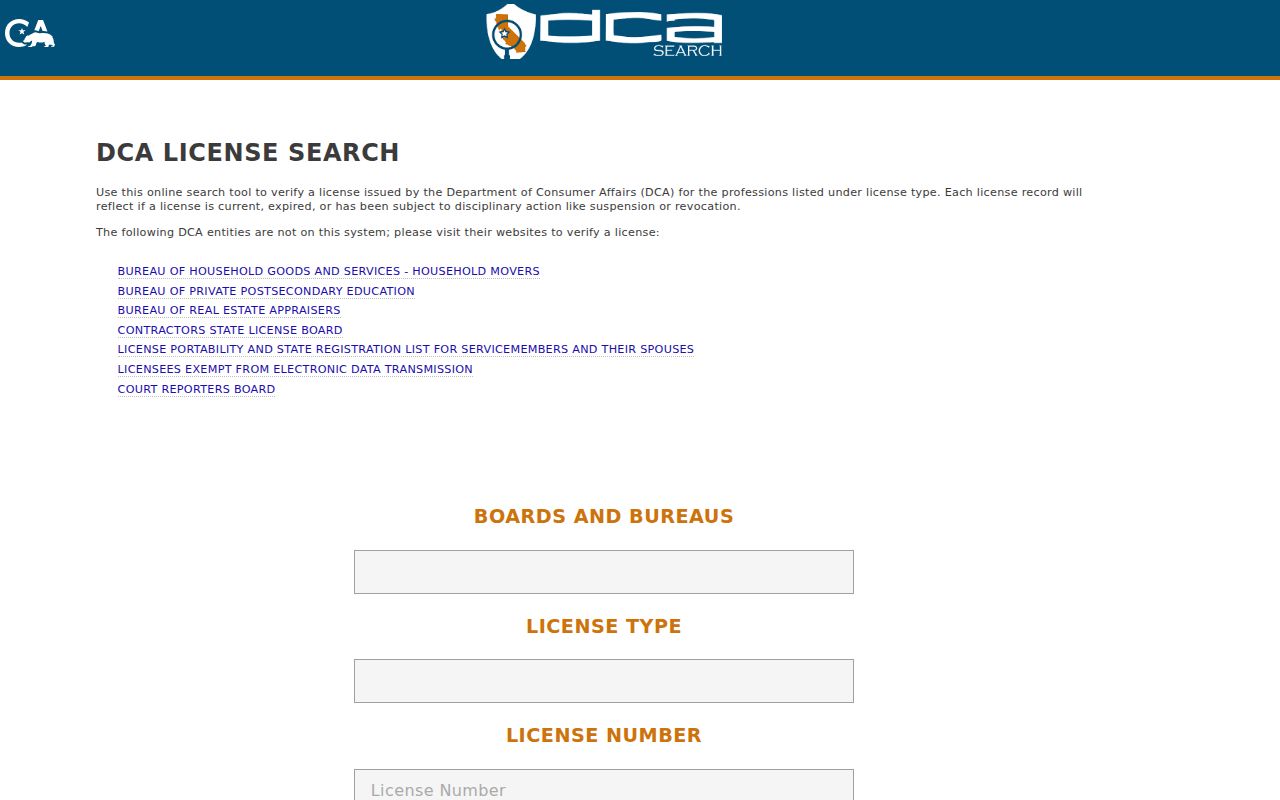
A license result confirms only the fields the board publishes. It is not a full identity profile or a guarantee that the listed address is a residence.
The California Secretary of State business search supplies a separate entity and filing path.
Filed addresses show business or agent affiliation. They do not establish personal residence.
Hemet Lookup Paths for Family Questions
Different personal questions call for different records. An heir search can combine a probate case, will or petition notice, obituary, and deed. A former-classmate search can start with a yearbook or local-history query, then add an obituary or telephone entry. A birth-parent question belongs with California adoption-record and court processes, not an informational birth certificate shortcut.
A business-owner question can use SOS entity filings and Riverside FBN records. A historical resident question can use the HSJGS index, Hemet News, census, and library shelf. The important step is to choose a source that contains the needed fact instead of asking a parcel map or voter status tool to answer a family question.
For an address-centered question about other people along a road, the Hemet by-street records path is the better handoff. A name-first Hemet resident lookup should keep the person and the purpose narrow.
Hemet Resident Records and DROP Privacy
California privacy law gives residents access, deletion, correction, and sale-or-sharing opt-out rights subject to exceptions under Civil Code §§1798.100 et seq. The DELETE Act created DROP at the California Privacy Protection Agency. The platform opened January 1, 2026, and registered data brokers began processing requests August 1, 2026. It is free and verifies California residence through the California Identity Gateway.
DROP addresses broker copies, not source records held by ACR, courts, the city, or a library. Safe at Home is another separate program. It provides a substitute mailing address and confidential voter registration for qualifying participants, but it is prospective and does not erase old public records or a property’s legal description.
The California DROP portal is the official place to check the deletion route for registered brokers.
When a Hemet resident lookup returns a wrong source record, contact the custodian named on that record. A broker correction or deletion cannot change the original deed, court entry, or city file.
Verifying a Hemet Resident's Records
Verification means matching the record to the right person and stating the limit of the result. A stable address, APN, legal description, case number, entity number, license number, exact event date, or close relative can serve as the second anchor. Do not treat a single name match as the final answer.
- Write the name in every known form, including middle initial, dates, relatives, and place.
- Choose the record that fits the question, such as a parcel, court, license, business, vital, or history source.
- Save the identifier and read the result fields, not just the search headline.
- Compare a second independent source, such as a deed plus obituary or a case number plus filing date.
- Order a certified copy only when the eligible custodian and the intended lawful purpose call for it.
A court index can establish that a named party appears in a case. An informational vital copy can establish a record clue while not establishing identity. A business filing can establish an entity role. The precise wording of the result is the heart of a defensible Hemet resident lookup.
Legal Limits on a Hemet Resident Lookup
California stalking law, criminal-threat law, identity-theft rules, the DPPA, and voter-file restrictions apply even when a fact came from a public record. Megan’s Law warns against harassment. Sealed, juvenile, confidential, adoption, protected-voter, and Safe at Home information cannot be opened simply because a name is known.
Use a Hemet resident lookup for lawful personal, family-history, property, safety, or civic research. If the request involves an emergency or a safety threat, use the proper public-safety channel. If the source is wrong, ask the custodian for correction. If a result is stale or merged, do not pass it along as fact.