
Finding Hemet Residents Along One Street
A street search in Hemet starts with one clean address. Write the number, the street name, and any directional suffix exactly as the county expects them. Then let each record answer one narrow question. The assessor and the map locate land. The recorder names parties to instruments. A permit shows work done at the address, a permitted voter file can show registration there, and an old telephone page shows a listed subscriber. None of these clues carries equal weight. No single record proves that a person lives at a property, so treat each result as one link in a chain. The Hemet street walkthrough is:
- Run the address through Riverside ACR Property Search and save the APN or PIN.
- Open RivCoView, center the parcel, and click adjoining polygons one at a time.
- Use the APN, legal description, or a lawfully available party name in the recorder index.
- Check Hemet eTRAKiT or a focused CPRA request for permit and city-file clues.
- For an older household, compare a telephone issue, the 1950 census, news, and obituary leads.
Keep the source and its date beside every result. A mailing address can differ from the situs, and a parcel owner can differ from the people actually using the address. Think of the output as a chain of evidence. It never proves that every nearby name belongs to one household.
Hemet Records Searchable by Street
Hemet records keyed by street sit across separate city and county systems. The table splits what an address search can yield from the limit that follows it. That split matters most for whole-block questions. A parcel map can be exact. A household list simply is not available.
| Record set | Keeper | What an address can show | Access |
|---|---|---|---|
| Property search | Riverside ACR | Parcel, situs, APN/PIN, assessment context | Free address or parcel search |
| GIS viewer | Riverside County | Parcel geometry and nearby polygons | Free map browsing |
| Recorded instruments | ACR Recorder | Named parties, dates, document numbers | Free index, paid copy |
| Permits | Hemet Building & Safety | Work, address, status, applicant clues | Online route or CPRA |
| Voter file | Riverside Registrar | Registration address under approved use | Restricted by Elections Code |
| Telephone pages | Library of Congress | Listed subscriber and telephone snapshot | Manual issue review |
Street-based work should start at the parcel row, then branch outward. The recorder keeps no direct street-address index. The voter route was never meant for casual browsing. Historic pages are snapshots of one issue. A missing subscriber may just be unlisted. In every case the record keeper decides what may be copied, certified, or corrected.
Hemet Street Records Begin with an APN
Riverside ACR Property Search accepts an APN, a PIN, or a property address. Its quick-search field is a text or autocomplete box. The county recommends a number plus street name, like "123 Main." If the full address fails, try a number-only form. A simpler street entry can also work. The public interface advertises no owner-name or ZIP search. This portal should never be counted on for a bulk name result.
| Field or control | Type | Required | Format or result |
|---|---|---|---|
| Quick Search | Text/autocomplete | No | APN, PIN, or property address |
| Property address | Address text | No | Number plus street name |
| Search | Button | Action | Runs the parcel query |
| PIN | Nine-digit text in RivCoView | No | Enter without dashes |
The returned record is a starting anchor, not a resident list. Save the APN or PIN, plus the property location. Also note any visible assessment or permit route it exposes. An owner mailing address is worth promising only on one condition. A verified result or a custodian response must actually supply it. The Riverside assessor GIS layer shows the countywide parcel-data context. That context sits behind this kind of address work.
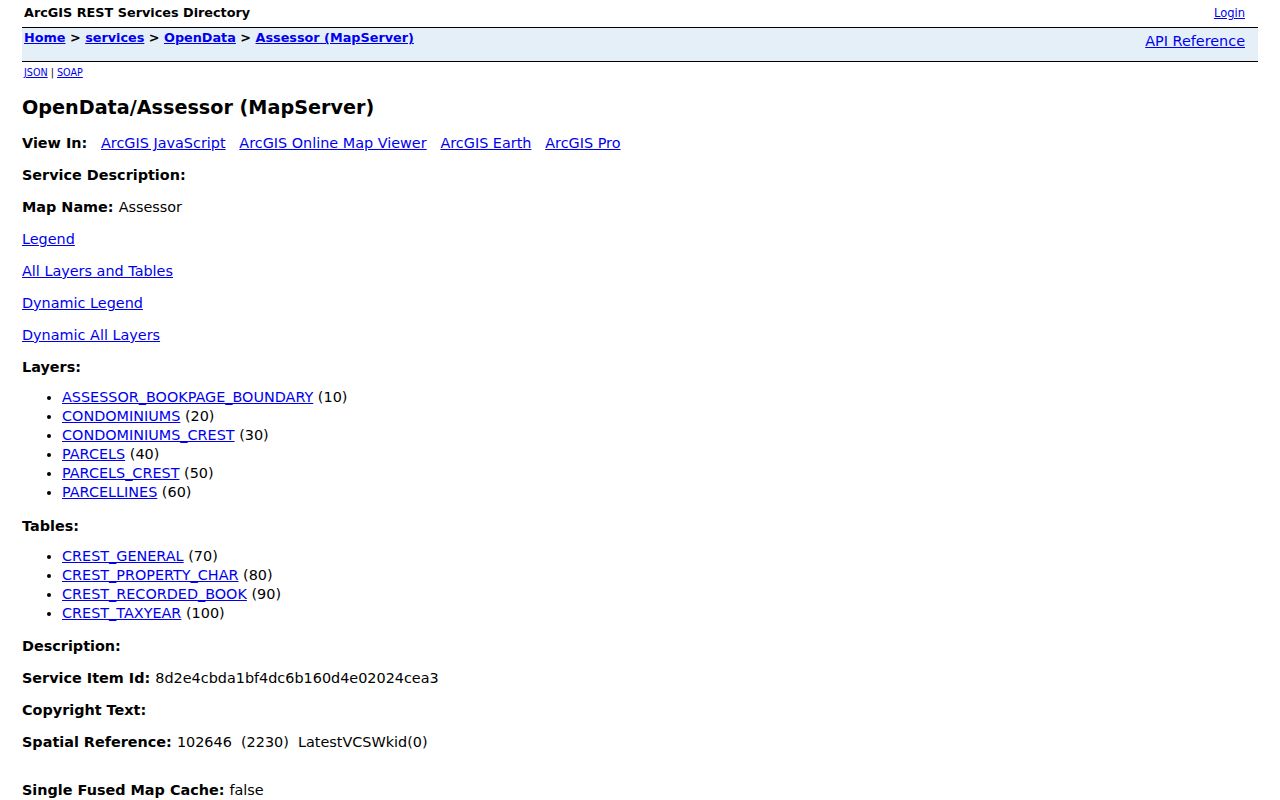
Treat that map layer as reference data, not as a substitute for a current parcel response. A consumer interface can show narrower fields than the county's internal layer does. When an address needs to become a parcel, the Riverside ACR property-search landing page is another official starting point.
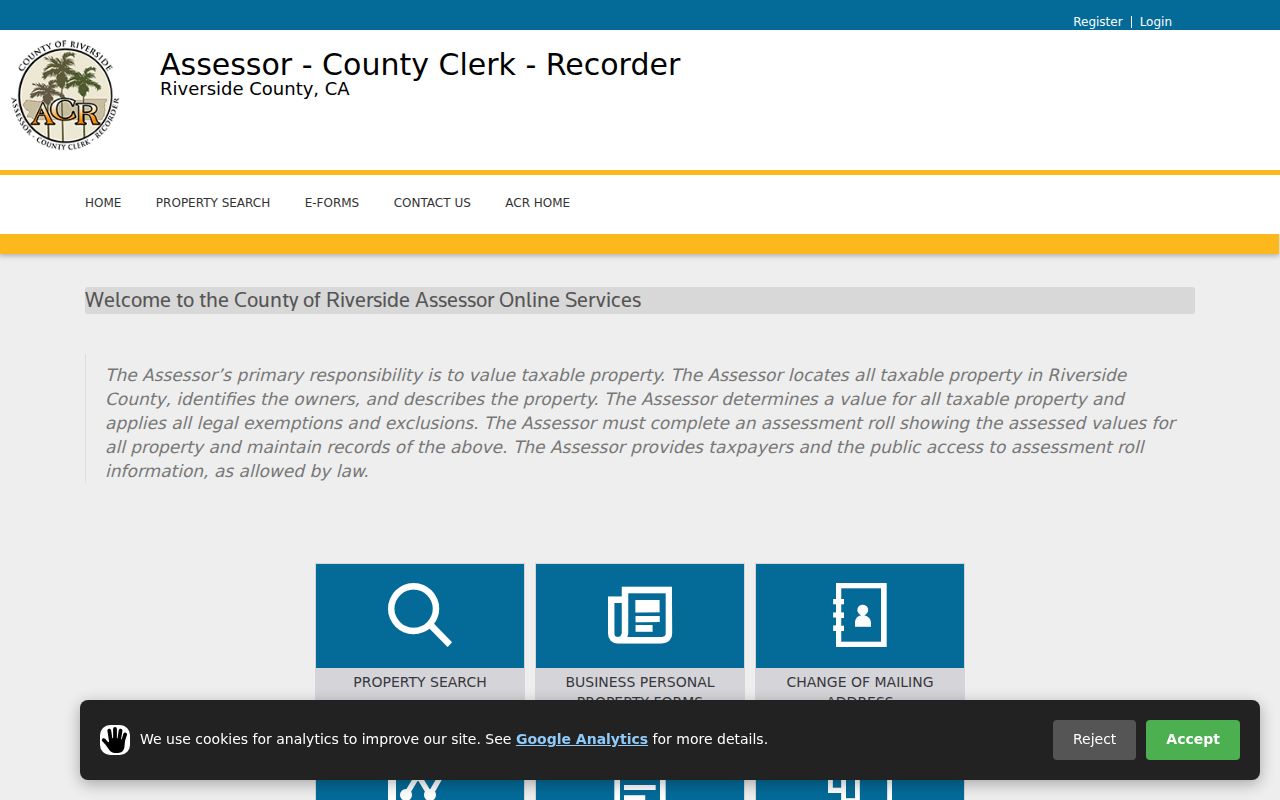
Use the returned APN or PIN as the stable handoff to the recorder and the map. The landing page itself is not a resident list.
Walking Hemet Street Records in RivCoView
RivCoView is the practical street-browse tool for Hemet parcel work. Search by a nine-digit PIN without dashes, or by number and street. Open Search Results, zoom or pan, and click each adjoining polygon. The Information panel opens more detail. It can lead to Assessment, Sales, Permits, Area Overview, Census, Education, and Map Layers. RivCoView offers no radius or buffer control. A block review means deliberate parcel clicks one at a time. Look at both sides of the street. Keep each parcel separate. A single address can cover more than one mapped piece. A nearby parcel can carry a different mailing address or a different owner. The map shows adjacency and linked context. It does not show social ties, household membership, or every person at an address. That makes RivCoView a strong Hemet parcel-search aid. It works when the goal is continuity along a street. It answers "who is home today" poorly. For that question, corroborate any current address clue. Use a record type that actually speaks to the person.
Hemet Street Records Need a Party Name
The Riverside recorder index is keyed to party names, recording dates, and document numbers, not to a street list. Book-page and map routes exist too. So the route used by the Hemet street directory begins with an address, converted first to an APN and a legal description. Then search the current indexed owner or grantee. Enter names as LAST FIRST MI, without punctuation. A tight query can relax to the last name plus a first initial, and Advanced Name Searching helps with stubborn spellings. Organizations go by their filed spelling exactly.
The advanced recorder search offers Name, Recording Date Start, Recording Date End, Document Types, and a Use Advanced Name Searching checkbox. Document-type choices load dynamically, so treat any list as incomplete. A search can also begin from Document Number. Document Type, Map Type, or Book/Page work too.
Index results are not deed images. They show party and date. Legal description, consideration, and APN details wait for a paid copy. To walk backward, search the grantor from the current acquisition as the next grantee, and the deed chain unfolds step by step. That chain is a deed trail, not a street-wide resident roll. The official Riverside ACR advanced deed index shows the name-and-date route the Hemet street directory depends on.
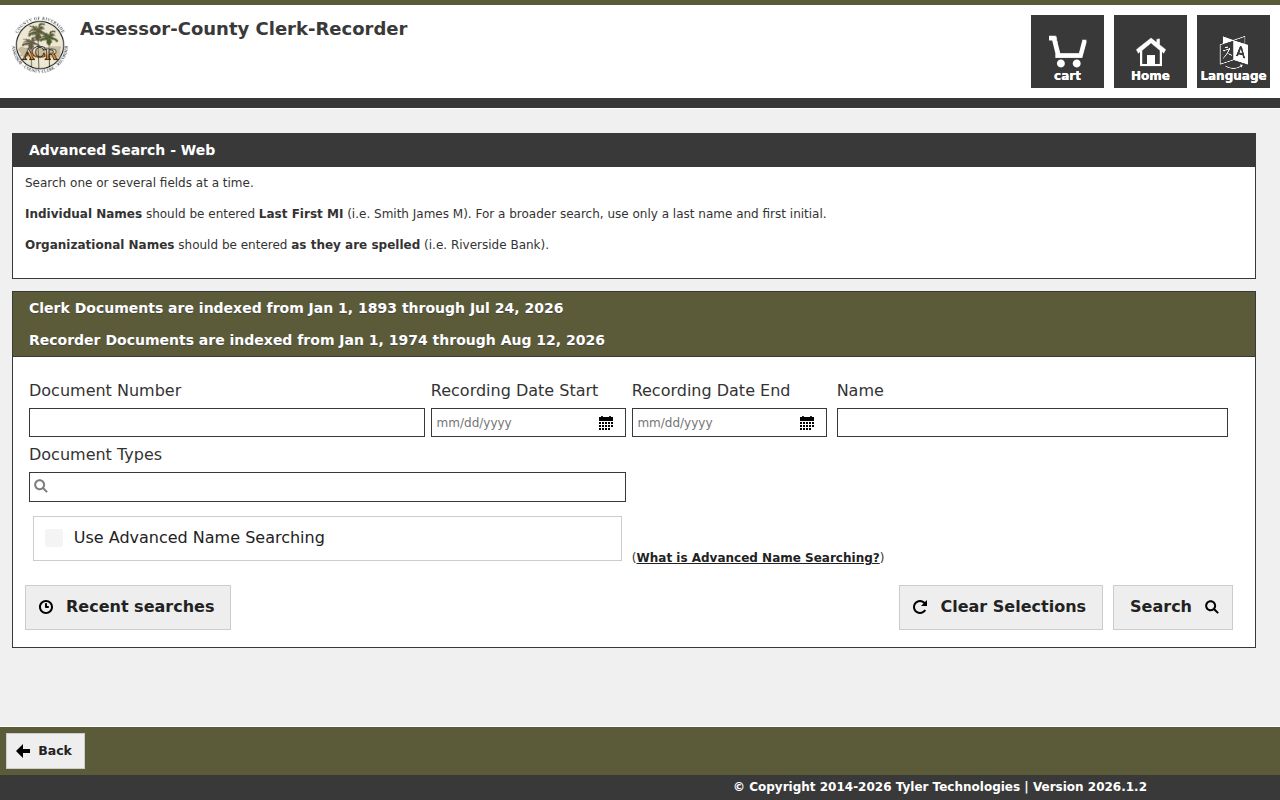
Keep the recording date and document number with the party spelling. Those details make a later copy request precise.
Hemet Permit Records Since 2000
Hemet's eTRAKiT instructions describe a permit search by permit number or site address. Permits generally reach back to January 1, 2000, with some 1990s records mixed in. Only numbers beginning with "B" are actual permits. If the address will not match, enter just the street number. Put a directional suffix after the street name.
A permit can show the work, its status, and a possible applicant or owner clue. It does not establish who occupied the parcel. Current permits and plans may route through Tyler Citizen Self Service, where account-dependent services apply. Older or missing files call for a focused Hemet CPRA request. Name the address, APN, date range, department, and record type. Building & Safety can identify the route at 951-765-2475. Code Compliance uses 951-765-2339. Phone paths confirm custodians and file routes, not private facts about people.
Hemet's Restricted Voter-by-Street Route
A public voter status tool checks the voter's own registration. It is not a name-and-street directory. Elections Code §2194 keeps affidavits confidential except for approved statutory purposes. Those purposes cover election, governmental, scholarly, journalistic, political, or similar uses. Protected voters, preregistered minors, driver-license data, ID numbers, and signatures stay outside ordinary release.
An approved statewide file request can include name and date of birth. It can also include registration date and residential or mailing address. Precinct, contact information, party preference, and active status round out the file. Election history and district files come as options. The request needs a purpose statement and a fee. A listed review takes 7-14 business days. County fees vary. No one can call that a casual whole-street search.
Use the voter route only when a Hemet street directory request qualifies. Protected categories must stay out. A registration address confirms a registration record, not physical occupancy, household membership, or ballot choice.
Reading Hemet Streets in Old Phone Books
The Hemet telephone holdings run from January 1943 through November 1952, November 1953 through November 1957, and November 1958 through September 1962. White pages show a listed subscriber, street address, locality, exchange, and number. Yellow pages sort businesses by category. Each volume is a listed-service snapshot. It does not prove every household had a phone. Nor does it prove every listed subscriber owned the property.
No Hemet reverse or criss-cross run is documented. A criss-cross directory starts with an address and points to a listed name. That definition is not evidence of a Hemet shelf series. Read each scan issue by issue. Record initials, spelling, address, and telephone exactly as shown.
The Hemet city directory collections page separates telephone pages from proven city directories and carries the full collection years with the household-history method. Pair a phone issue with the 1950 census. A newspaper or an obituary lead strengthens older Hemet street directory work.
Hemet Street Address and Legal Description
Address labels are convenient. Legal descriptions are durable. A deed may carry a lot, block, subdivision, or metes-and-bounds description that outlives any change in address form. The APN is another continuity key, so keep both beside the current address before searching backward or comparing a historic map.
- Parcel
- A mapped land unit with an APN or PIN. One parcel can contain many people, and one person can connect to more than one parcel.
- Situs address
- The physical location used to place the parcel. It is different from a tax mailing address.
- Plat
- A recorded map that lays out lots, blocks, streets, or easements in a subdivision.
- Criss-cross directory
- An address-first directory concept. No verified local Hemet series was located, so the term is a definition, not a collection claim.
No Hemet-wide street renumbering or renaming year is documented. If an older address seems to vanish, ask city GIS or engineering for addressing records. Use the APN or legal description as the bridge. Never invent a conversion year from a single mismatch.
Hemet Street Records and ZIP Jurisdiction
USPS pairs 92543 through 92546 with Hemet, yet postal zones are not city limits. Parts of East Hemet carry a Hemet mailing address while sitting outside the incorporated line. Treat a ZIP code as jurisdiction. A records request can then land at the wrong office.
Check delivery status with USPS first. Then confirm jurisdiction through city or county GIS mapping. The parcel's situs fixes the physical location; the mailing address handles correspondence. A ZIP only works as a search filter when the tool truly supports one. Neither ACR Property Search nor RivCoView offers a ZIP-wide resident mode.
What a Hemet Street Directory Misses
No single address record lists every non-owner occupant. The parcel roll is not a household census. The voter route stays restricted. DMV addresses sit behind the federal DPPA. Utility-customer files are no public street directory. A permit shows the work done, not who lives there.
Use a street record for lawful personal, family-history, property, or civic questions. Keep each claim no wider than the source behind it. Where a correction process exists, use it. When a public record is not posted, ask the named custodian directly. Describe the record narrowly.
The strongest Hemet street directory result is a documented chain. Address leads to APN. APN leads to the legal description, the legal description to a named instrument, and the historical source to a dated listed person. Anything past that chain demands a new source.
Crossing Hemet's 1974 Records Line
Two different archive breaks complicate Hemet research. The online recorder line and the county boundary line do not match. ACR's online recorder index begins in 1974, but the county itself formed in 1893. A pre-1974 deed belongs with Gateway and the older books. A pre-1893 Hemet-area record may instead sit under predecessor San Diego County. A missing online result might mean the wrong time range. It might also mean the wrong county label or the wrong record series.
Pack the request with the APN, legal description, party spelling, book-page clue, and approximate date. The older trail may run through the ACR office. It could also lead to the Duffin Heritage Room, HSJGS, the museum, or a focused archive question. A street directory serves you best when it names the next custodian. It should not paper over an archive gap with a guess.